 EN

How to Choose a Cosmetic Tube Supplier for Custom Packaging Projects
Choosing among cosmetic tube suppliers is not simply a matter of comparing unit prices. For a brand launch or a packaging refresh, the tube has to suit the formula, the intended consumer experience, the artwork, the filling process, and the way the project will move from samples into repeat production. A useful starting point is to treat the supplier conversation as a specification exercise, not a catalogue search.
That shift matters because a tube that looks right in a digital mock-up can still create delays if its material, shoulder, cap, decoration, or fill behavior has not been discussed early. The most dependable selection process lets a brand compare cosmetic tube suppliers on the same brief and verify the risky details before a bulk purchase order is released.
Start with the product and use case, not the tube finish
Before requesting quotations, define what the package needs to do. Is the product a facial cleanser, cream, sunscreen, hand treatment, lip product, or another personal-care formula? Is the tube intended for retail shelves, e-commerce shipment, travel use, or professional distribution? These answers shape the shortlist more effectively than a request for a “premium tube” alone.
- Formula considerations: share the product type, viscosity, and any known ingredients or storage conditions that may affect material compatibility.
- Dispensing experience: specify whether controlled dosing, a narrow nozzle, a flip-top cap, a screw cap, or an applicator-style head is needed.
- Capacity and format: identify the target fill volume, diameter range, standing or non-standing format, and any limits set by a carton or display.
- Channel needs: state whether the packaging must withstand mailing, humid climates, frequent handling, or long retail display periods.
Many sourcing teams initially concentrate on appearance. In practice, the better order is to confirm formula compatibility and filling conditions first, then refine the visual direction. Packaging compatibility work commonly reviews issues such as stability, leakage, dispensing, and package performance before a project reaches mass production. The exact test plan should be agreed by the brand, filler, and supplier for the specific formula.
Compare material and construction capabilities on a like-for-like basis
When shortlisting cosmetic tube suppliers, ask every candidate to respond to the same material, size, and closure brief. A side-by-side response makes differences visible before the team compares price.
A supplier may offer PE, laminated, or aluminum-barrier constructions, but the right choice depends on the project rather than on a universal hierarchy. Ask each candidate to explain which tube structures they can quote for the same application and what information they need before recommending one. This makes it easier to compare cosmetic tube suppliers fairly.
| Evaluation area | Questions to ask | Why it matters |
|---|---|---|
| Tube body | Which material structures are available for this formula and target look? | Material selection affects feel, decoration options, and compatibility review. |
| Size range | Which diameters and fill-volume ranges can be supported? | Dimensions influence shelf presence, carton fit, and filling setup. |
| Shoulder and opening | What shoulder styles, nozzle options, and sealing approaches are available? | These details shape dispensing and the production conversation. |
| Cap system | Which cap types pair with the selected tube, and what must be sampled together? | The cap and tube should be evaluated as one user-facing system. |
For example, a brand can review an available custom cosmetic packaging tube range as a starting point for discussing ABL, PBL, or PE options, volumes, diameters, and decoration needs. It is still important to confirm the final construction against the actual project brief rather than assuming that any listed configuration fits every formula.
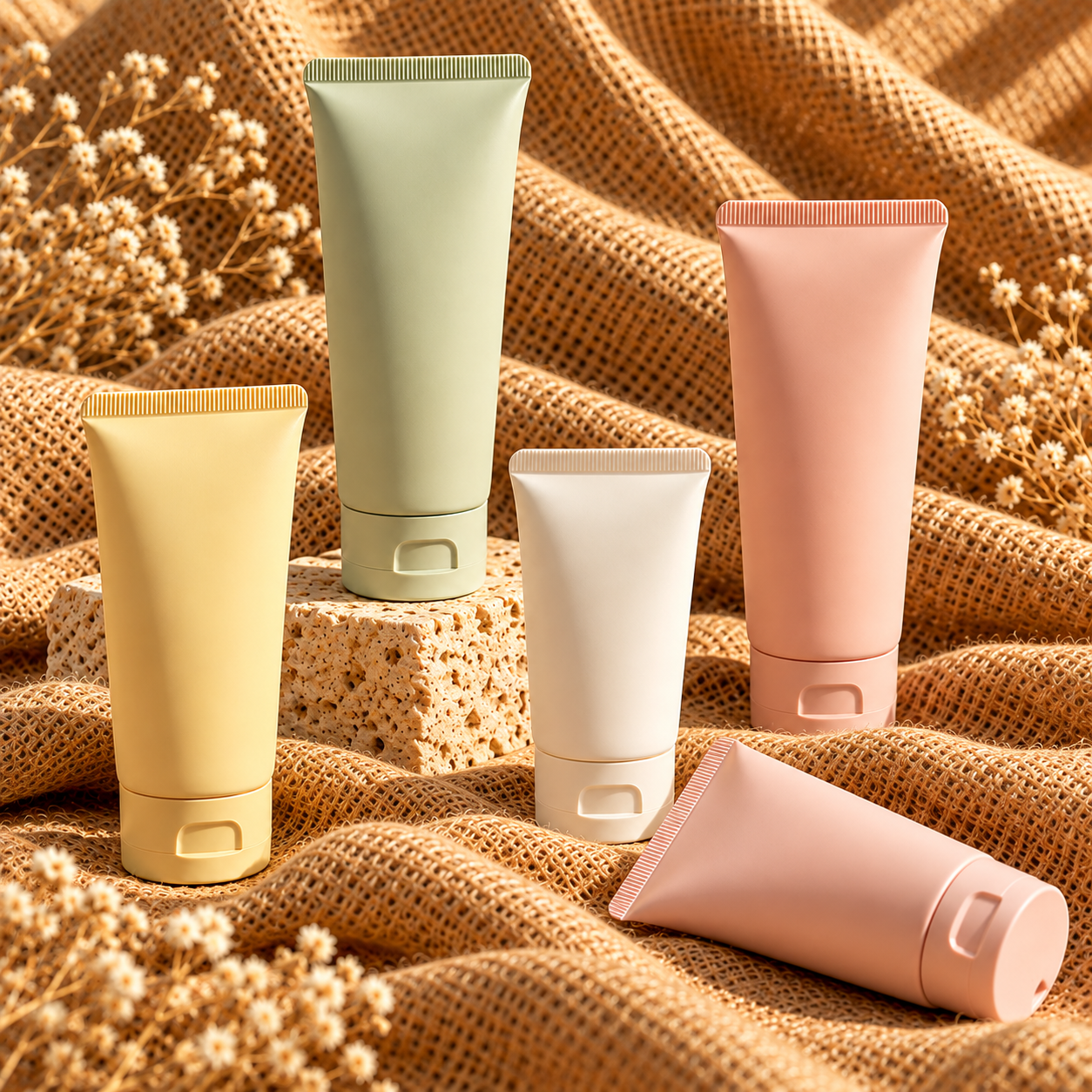 Compare tube construction and closure options against one shared project brief.
Evaluate customization as a controlled process
At this stage, cosmetic tube packaging suppliers should be able to translate a design direction into a documented artwork, decoration, and sampling sequence. If the process remains vague, the brand cannot compare custom offers reliably.
Custom packaging has several moving parts: color, artwork, surface effect, printing method, cap selection, and the agreed visual standard. Strong cosmetic tube packaging suppliers make these decisions easier to review by turning a broad creative direction into an approval sequence.
Ask how artwork files are checked, what proof or sample stages are offered, what visual tolerances need agreement, and how changes are recorded. A supplier does not need to promise that every effect will reproduce exactly from a screen; a more useful response identifies the items that should be verified on physical samples. This is especially important when the project relies on fine typography, gradients, metallic details, matte surfaces, or color matching across multiple SKUs.
Also leave adequate printable space for the information required in the target market. For example, cosmetic labeling obligations can vary by country, and U.S. requirements include ingredient-declaration rules in applicable situations. Brands should have their own regulatory or labeling team review the final copy and layout before production.
Use samples to test communication as well as the package
For cosmetic tube suppliers, a sample request is also an opportunity to show how the team handles a detailed brief, clarifies assumptions, and controls changes before production.
Samples are a decision tool, not merely a visual formality. When comparing cosmetic tube suppliers, evaluate how clearly each candidate captures the brief and responds when details are incomplete. A productive sample review usually covers the tube body, cap fit, dispensing behavior, print appearance, dimensions, and any formula-related compatibility checks defined for the project.
- Send one written specification sheet to every shortlisted supplier.
- Request a clear record of assumptions, unavailable options, and questions before sampling.
- Review samples against agreed criteria, including appearance and functional handling.
- Document revisions so the approved version can be traced into the purchase order.
It may feel slower to document these points at the beginning. However, that discipline often reduces ambiguity once artwork, filling, logistics, and purchasing teams are all involved.
Check readiness for the move from sample to bulk order
Cosmetic packaging OEM coordination is more reliable when packaging, filling, and brand teams agree on the records that move from the approved sample to a bulk order.
A sample that looks promising is only one part of supplier suitability. Ask how the supplier manages production specifications, packaging of finished tubes, lead-time planning, inspection communication, and change control. For brands serving multiple markets or planning repeat orders, these operational questions can be as important as the initial design result.
- Can the supplier restate the approved specification in a form the purchasing team can use?
- Are the responsibilities for artwork approval, formula testing, filling trials, and final inspection clear?
- What information will be needed if the order volume, cap choice, artwork, or destination changes?
- How will the brand and supplier communicate deviations before shipment?
For a cosmetic packaging OEM project, the most useful conversation usually connects the packaging supplier, brand owner, and filler early. Each party sees a different risk, and early alignment helps prevent a visually attractive tube from becoming a production bottleneck.
A practical supplier-selection checklist
Use this final check to compare cosmetic tube suppliers on evidence rather than on a single quotation or a visually attractive sample.
Before deciding, score each candidate against the same evidence rather than relying on the fastest reply or the lowest initial quote:
- Relevant material, size, and closure options for the intended formula and market.
- A clear customization path for artwork, decoration, and physical approval.
- Responsive questions and transparent assumptions during sampling.
- A documented route from approved sample to bulk production.
- Willingness to coordinate around compatibility, filling, labeling, and inspection responsibilities.
When these criteria are applied consistently, cosmetic tube supplier selection becomes a repeatable purchasing process. You are not just buying a tube; you are choosing a partner who can help convert a defined packaging brief into an approved and scalable project.