
 EN

How to Source Custom Toothpaste Packaging Tubes
Buying a toothpaste packaging tube is not simply a matter of choosing a size and sending a logo. For oral-care brands, contract fillers, and packaging buyers, the tube is a small but consequential system: it has to protect the formula, work with a filling line, dispense predictably, carry compliant artwork, and arrive in a form that supports repeat production. The most effective sourcing process turns those requirements into a single, version-controlled specification before quotations are compared.
This guide is written from a B2B packaging-procurement perspective. It focuses on the questions that should be answered before an RFQ, the tests that should be completed before mass production, and the supplier evidence worth requesting when evaluating a custom toothpaste packaging tube.
Start With the Product, Not the Decoration
Begin with information about the toothpaste itself. The formula, target shelf life, filling process, market requirements, and intended use determine which tube structure is worth evaluating. A packaging brief that starts only with a reference image tends to leave important decisions until late in sampling.
- Formula and filling conditions: Describe the product type, any relevant ingredients or sensitivities, fill temperature, filling method, and the tests your team expects. A stronger barrier claim alone does not prove that a specific toothpaste formula is compatible with a tube; validation should use the actual product.
- Capacity and dosing: State the nominal fill volume and the acceptable tolerance used internally. Consider whether the tube should support everyday family use, travel use, or a premium oral-care format.
- Market and artwork requirements: List the markets, languages, mandatory copy, codes, and reserved print areas. This helps prevent a technically correct tube from becoming too crowded to approve visually.
- Target schedule and forecast: Share the first order quantity, expected repeat volume, and desired launch window. Suppliers can then align sampling, artwork proofing, production, and shipment planning around the same version of the project.
Specify the Tube Structure and Material Options
Material selection for a toothpaste packaging tube should be a comparison of application requirements, not a generic material choice. Laminate formats such as ABL and PBL are commonly considered for toothpaste applications because buyers often need barrier performance, a stable tube body, and practical filling compatibility. The appropriate structure still depends on the formula, decoration, sustainability objectives, and supplier validation plan.
Ask each supplier to identify the proposed tube body construction, shoulder, neck, seal area, and cap material. Request plain-language explanations of why the proposed structure suits the project, along with the checks they recommend. If recyclability or reduced-material goals are part of the brief, ask what can be documented for the exact construction—not just for a similar tube in a catalogue.
For a starting point, buyers may review a custom ABL laminated toothpaste tube format when considering how capacity, laminate construction, and custom printing can be organized in one sourcing brief. The final selection should be confirmed against the actual formula and project requirements.
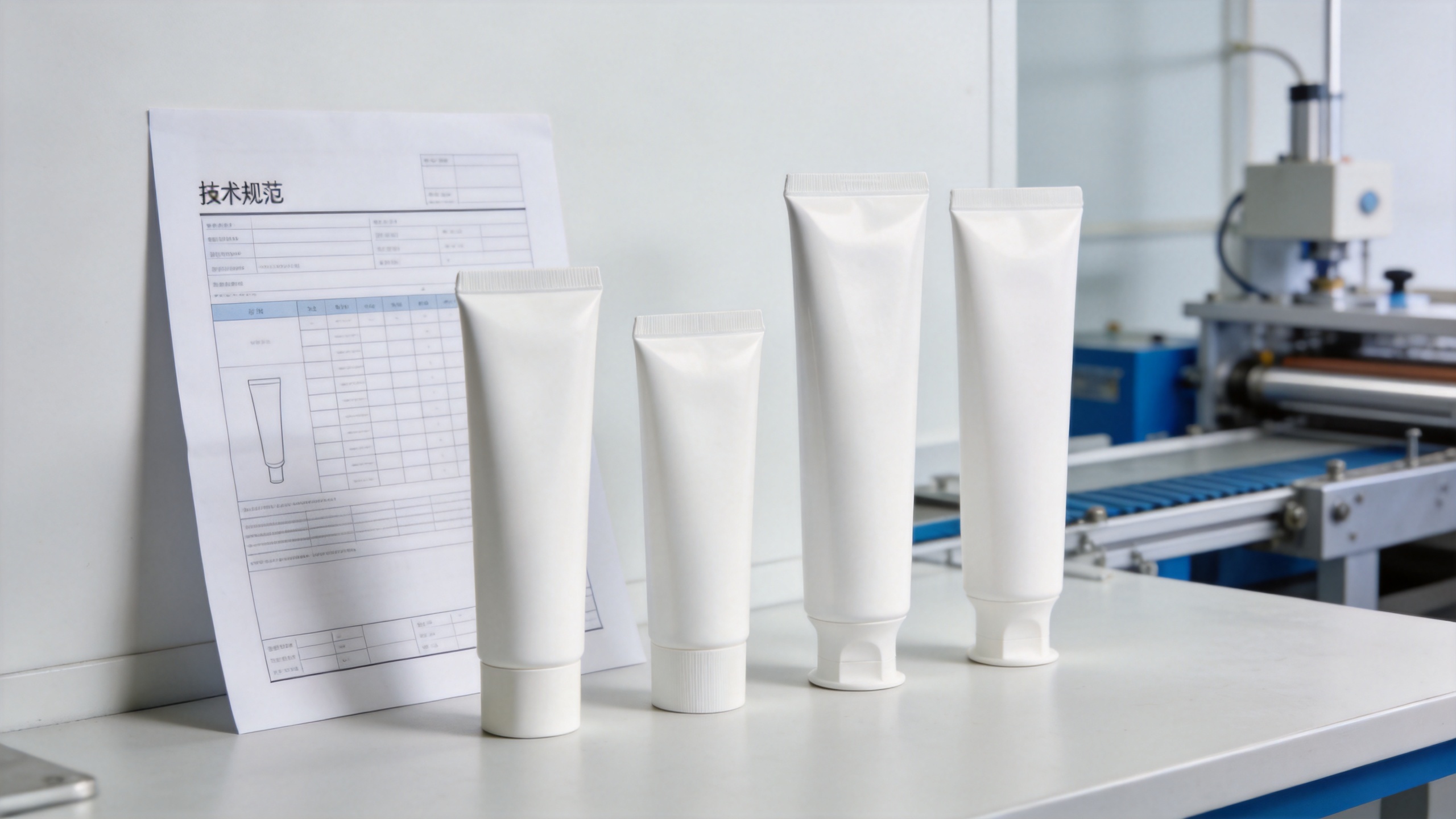
Lock Down Dimensions, Opening, and Cap Before Sampling
For a toothpaste packaging tube, capacity is only one part of the specification. Tube diameter, length, shoulder geometry, neck finish, opening diameter, and cap type affect both visual proportion and daily dispensing. They can also affect how the tube performs on the filling line and in transit.
| Specification area | What to define in the RFQ | Why it matters |
|---|---|---|
| Tube size | Fill volume, diameter, target length, and dimensional tolerance | Supports shelf presentation and filling planning |
| Opening and neck | Opening style, outlet diameter, and neck requirements | Influences dispensing feel and cap fit |
| Cap | Flip-top, screw cap, color, finish, and tamper-evidence needs | Defines user handling and assembly checks |
| Seal and end treatment | Seal format, coding area, and orientation expectations | Helps coordinate filling and final-pack inspection |
Where a brand uses a particular filling machine or cap-handling process, involve the filler early. It is easier to flag an unsuitable neck or cap combination during technical review than after printed samples have been approved.
Plan Printing and Artwork as a Controlled Approval Process
Custom printing is where cross-functional confusion can grow quickly. Brand, regulatory, procurement, and manufacturing teams may each work from a different artwork file. Prevent this by defining the artwork version, print method to be quoted, color reference, finish, readable-copy requirements, and approval owner before a supplier releases production.
Ask for a digital proof to verify copy, placement, and layout, then use a physical sample or production-representative proof to assess color, registration, finish, and legibility on the curved surface. Separate artwork approval from structural approval: a beautiful print sample does not replace leakage, cap-fit, or filling validation.
Build a Sample Plan That Tests the Real Risk
A sample is most useful when it answers defined questions. For a custom toothpaste packaging tube, create a simple sign-off sheet that identifies which items are visual checks, which are dimensional checks, and which require the actual formula or filling equipment.
- Confirm dimensions, tube feel, cap assembly, and basic appearance.
- Review artwork placement, color expectations, and readable information against the approved file.
- Conduct agreed leakage, dispensing, and closure checks.
- Where relevant, run formula-compatibility and filling trials with the intended product and process.
- Record deviations, assign an owner, issue a revised specification, and approve the final version before production.
This sequence makes the sample a decision tool rather than a display item. It also gives buyers a clearer basis for comparing supplier responses when a quote includes different assumptions.
Evaluate Suppliers Beyond the Unit Price
At the decision stage, compare suppliers on their ability to respond to the same brief. Request a quotation that separates tooling or setup assumptions, material construction, decoration, cap configuration, sampling route, production lead time, packing method, and commercial terms. If a response is vague, ask the supplier to identify the open items rather than filling the gaps with assumptions.
For recurring programs, it is useful to ask how the supplier controls specification revisions, print approvals, quality records, and communication when a change is requested. The goal is not to seek an absolute promise; it is to understand the process that supports consistent execution from approved sample to repeat order.
Approval Matrix for the Final Packaging Specification
Use this compact matrix to make each review item traceable. It gives purchasing, brand, and filling teams a shared record before production authorization.
| Control point | Buyer question | Evidence to request | Approval owner |
|---|---|---|---|
| Formula review | Has the intended formula been identified? | Compatibility plan | Technical lead |
| Barrier selection | Which structure is proposed? | Material description | Packaging lead |
| Capacity check | Is fill volume confirmed? | Dimensional drawing | Buyer |
| Outlet review | Is dispensing acceptable? | Cap-fit sample | Filler |
| Artwork control | Is the file version correct? | Signed proof | Brand owner |
| Color check | Are visual expectations defined? | Approved sample | Brand owner |
| Leakage test | Which acceptance rule applies? | Test record | Quality lead |
| Filling trial | Is line testing required? | Filling feedback | Operations lead |
| Packing plan | How will units be protected? | Packing specification | Logistics lead |
| Revision control | What version is released? | Release record | Project owner |
| Production release | Are open deviations closed? | Final sign-off | Approval team |
Use an RFQ Checklist for Your Toothpaste Packaging Tube
Before sending the inquiry, consolidate the following into one buyer-ready document:
- Formula and filling information needed for evaluation
- Target volume, dimensions, opening, and cap configuration
- Preferred tube structure and questions to validate
- Artwork files, color/finish expectations, languages, and coding needs
- Sample, leak, cap-fit, compatibility, and filling-test expectations
- Order quantity, forecast, destination, packing, and required timeline
- Named approvers and a clear rule for version changes
A well-structured request helps a supplier quote the same project your technical and brand teams intend to launch. By treating material, dimensions, artwork, sample approval, and delivery preparation as connected decisions, buyers can source a toothpaste packaging tube with fewer late-stage revisions and a more reliable path to production.